
This is an 8-page zine– Folding instructions here
You’ve seen them growing on trees, on rocks, on buildings, and pretty much anything stationary. But what the heck are they?
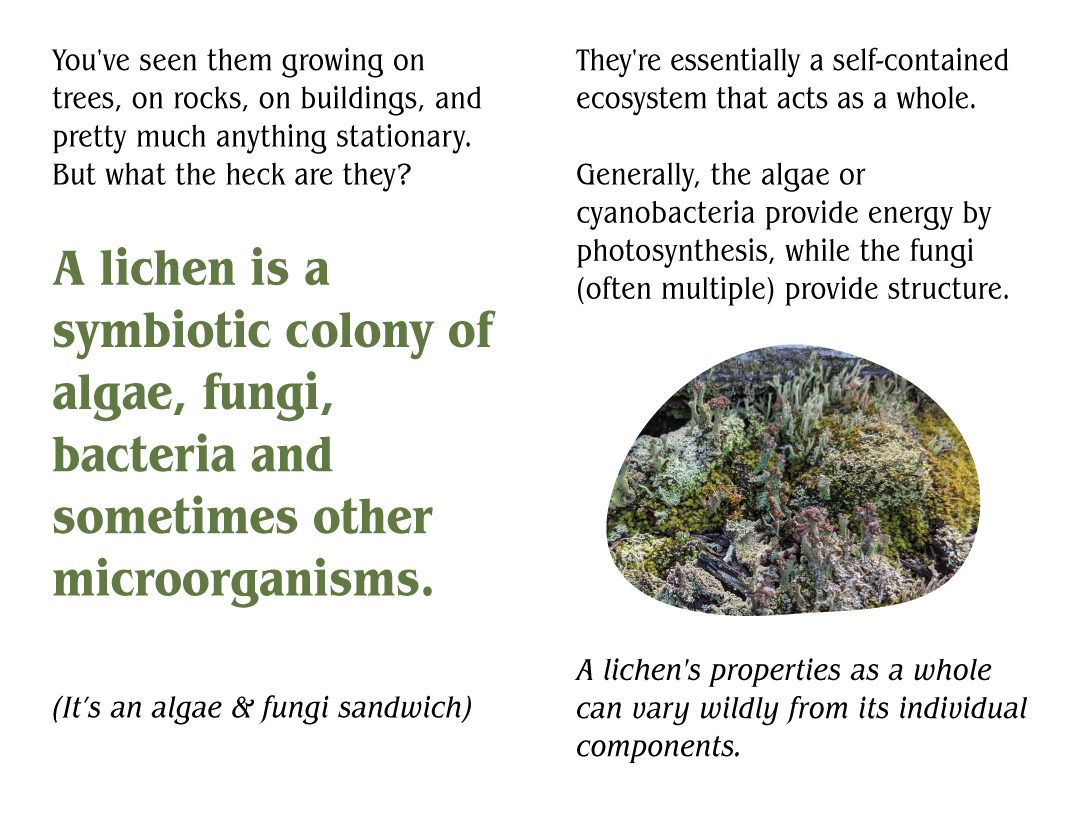
A lichen is a symbiotic colony of algae, fungi, bacteria and sometimes other microorganisms. (It’s an algae & fungi sandwich!)
They’re essentially a self-contained ecosystem that acts as a whole.
Generally, the algae or cyanobacteria provide energy by photosynthesis, while the fungi (often multiple) provide structure.
A lichen’s properties as a whole can vary wildly from its individual components.
While sometimes lichens may look like a shrub or have leaf-like structures, they aren’t closely related to plants at all. In fact, they can also look like a powder, a flat crust, a gelatinous blob, a stringy moss, or other forms.
Lichens occur in all elevations, on almost any surface, given the right conditions. You might think of them growing on trees and rocks. They can also grow on metal, sand, plastic, rubber, bone, living tortoises, other lichens and mosses, hanging from trees, even between the grains of solid rocks.
There are around 20,000 known species of lichens.
- Some species are known to absorb heavy metals from the air
- Lichens from Antarctica have survived 18 months in the extreme conditions of space
- There’s a living specimen in Canada estimated to be 9500 years old
While we understand a fair amount about lichens, there is still a lot to learn. Until 2016, scientists had overlooked yeasts as a crucial component of some species.
Search terms for a deeper dive:
- lichen dyes
- lichen panspermia
- lichen classification
- lichen reproduction
 Great Joy Collective
Leave a comment